Pine and Eucalyptus Log Producer
We grow high-quality forests

Planting and Growing with the Forest
Based in south-central Paraná and northern Santa Catarina, Remasa grows high-quality forests to supply the forest products industry in Brazil and around the world.
Today, Remasa ranks among the three largest independent producers in Brazil’s pine log market, with production capacity exceeding 600,000 metric tons per year.

Ethics, responsibility, commitment and a focus on results have guided our journey since November 29, 1973.

A Focus on People, Sustainability and the Economy
When Remasa began producing timber 50 years ago, our lasting commitment to people began with it. Our management approach has always been rooted in ethics, care, development and respect. We want everyone in the company to experience these values every day.
The market for timber from planted forests plays an important role in the economy and environmental conservation, showing how these two priorities can coexist in balance.
We operate in one of the world’s most competitive agribusiness sectors, helping conserve natural resources, protect soil, improve air quality and preserve biodiversity. We create jobs and income in rural areas, supporting social inclusion and regional development.
What Sets Us Apart
600,000
metric tons of logs per year in production capacity
Commitment to Environmental Responsibility
38,300
hectares of company-owned land
18,100
hectares of planted forests
18,800
hectares of permanent preservation areas
Social Commitment
We support communities near our forest properties through social projects and investment in infrastructure and local employment.
30M+
trees planted
1.5M
seedlings produced each year
High-Quality Timber Production

Remasa Receives Consecutive Great Place to Work Awards
The awards Remasa receives recognize our longstanding commitment to our people and affirm a culture that we respect, nurture and develop with every employee. They reflect how strongly our team values and believes in the company’s management approach, and how proud they are to work at Remasa.
These awards are an honor and an opportunity to reflect on the importance of agribusiness in Brazil, particularly the planted forest sector.
Timber with Remasa Quality
When selecting species for planting in our forest management units, we consider productivity as well as suitability to local environmental conditions, sunlight, climate and biodiversity.
Pine wood is widely used in furniture manufacturing and construction. Its long fibers also meet demand for stronger packaging. Grown in planted forests, it offers durability, strength and good value.
Pine wood characteristics:
- Versatile, supplying paper mills, sawmills, veneer mills and panel manufacturers;
- Meets demand for lighter-colored wood;
- Long fibers suitable for strong packaging paper, newsprint and other paper products;
- Potential for resin extraction on a commercial scale;
- Hardiness and tolerance of a wide range of soil and climate conditions, adding value to land through timber production;
- Fast growth and straightforward management in planned plantings;
- A sustainable product sourced from planted forests.
The Remasa Group also has remaining planted forests of the genus Eucalyptus, accounting for approximately 3% of its commercial plantings. The Eucalyptus species grown include E. badjensis, E. benthami and E. dunnii.
Eucalyptus wood has short fibers, which are important for producing soft, absorbent paper. Other common uses in our local timber industry include medium-density fiberboard, MDF (Medium Density Fiberboard), for furniture manufacturing, as well as biomass used to fuel industrial boilers.
The market we currently serve has limited demand for this genus, with most demand met by the buyers’ own plantings.
How Is Our Timber Produced?
Stage 1: Planting

Forests are established through clearly defined stages. First, the site is prepared by mulching stumps, branches and other residual material. Planting rows are then marked out, planting holes are opened and seedlings are placed in them. Alongside these activities, leaf-cutting ants and competing vegetation are controlled through cutting or herbicide application.
Stage 2: Growing
Forest establishment begins with proper site preparation and respect for nature. Planting is carried out by hand using minimum tillage, with a Chilean planting spade as the main tool for opening planting holes and placing seedlings.
Competing vegetation is controlled through manual and mechanized herbicide application, hand weeding, manual cutting and semi-mechanized cutting with brushcutters.

Stage 3: Harvesting

Timber harvesting has two stages: thinning and clearcut harvesting.
During the first thinning, between nine and eleven years of age, every fifth row is systematically harvested, along with selected lower-quality trees.
During the second thinning, between fourteen and fifteen years, 50% of the trees are selectively removed, leaving only higher-quality trees for clearcut harvesting. In this final stage, the remaining trees are harvested under an efficient management plan.
The CTL (Cut-to-Length) system is used throughout the cycle. A harvester equipped with a forestry head fells and processes trees at the stump, while a forwarder carries logs to the road for loading. This method provides mobility over short distances with limited environmental disturbance, reflecting our commitment to balanced timber production and environmental preservation.
Stage 4: Processing
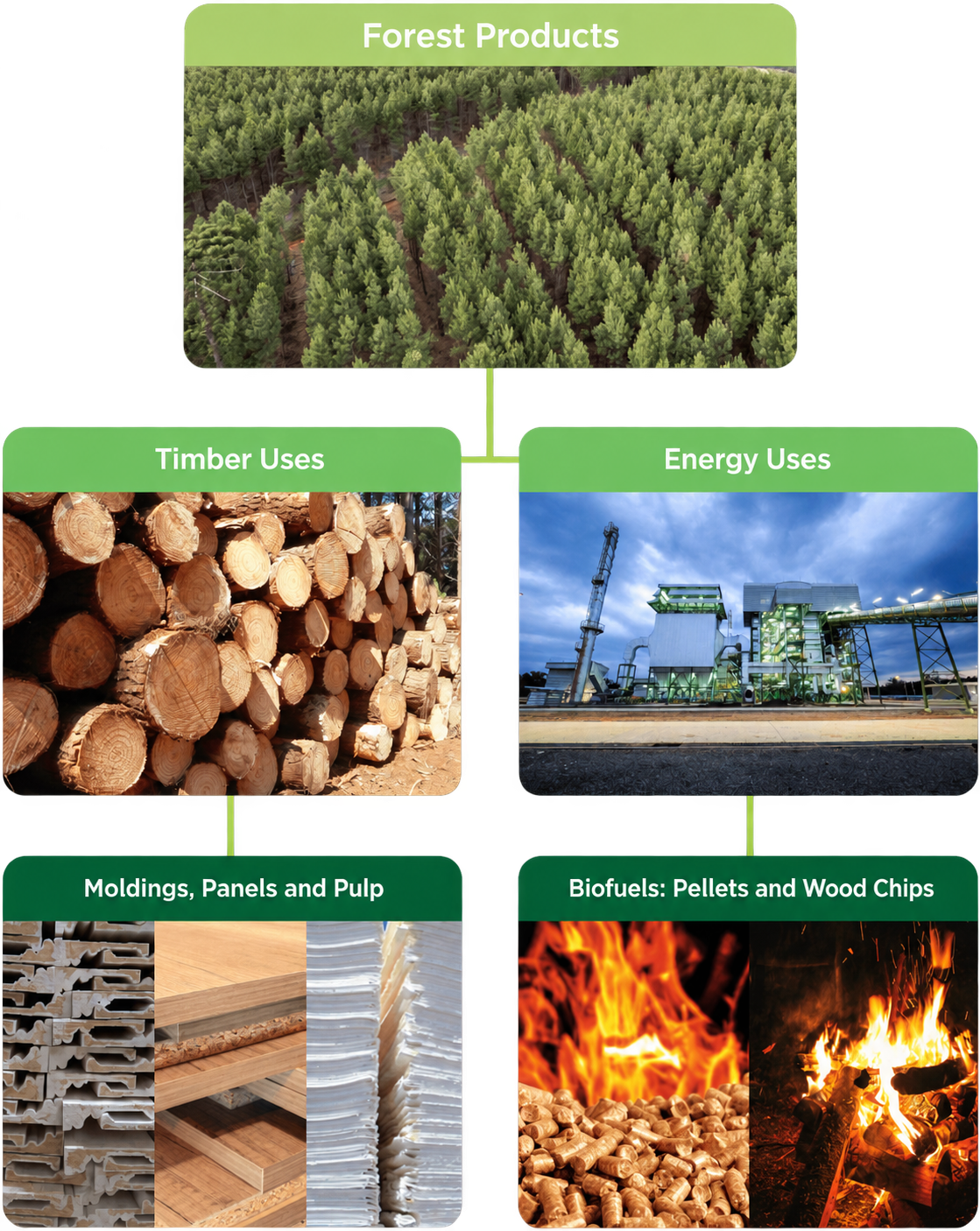
Further timber processing takes place in the customer’s industry, for energy and wood products. Thicker logs, usually from clearcut harvesting, are used to produce slats and boards for construction, including beam and crate components.
Medium-sized logs are used to manufacture plywood, veneer and moldings such as baseboards, trim and decorative accessories. These products are shipped abroad, with 100% of the items produced leaving the country.
The thinner sections and tops are used for pulp and biomass, respectively, with pulp accounting for approximately 30% of total production and shipments. For biomass, logs are processed into wood chips and pellets to fuel thermal equipment such as boilers and furnaces.

Stage 5: Construction

After processing, wood serves a range of markets, including paper manufacturing and wooden packaging such as pallets, used to store and transport goods, often large items over long distances.
After veneer and plywood manufacturing, these products are used mainly in construction and shipbuilding. Treatment protects them against fungi and termites, while high-temperature pressing with marine-grade phenolic adhesive provides strong resistance to moisture and direct contact with water. Moldings and construction accessories include baseboards, crown moldings and door trim, with 100% of these products destined for export.

Environmental Management, Conservation and Preservation
Our planted forests coexist in harmony with extensive conservation and preservation areas that protect water sources, wildlife and plant life, and help regulate rainfall patterns.
Forest Management Plan
Learn more about our company and how we work in our Forest Management Plan.